
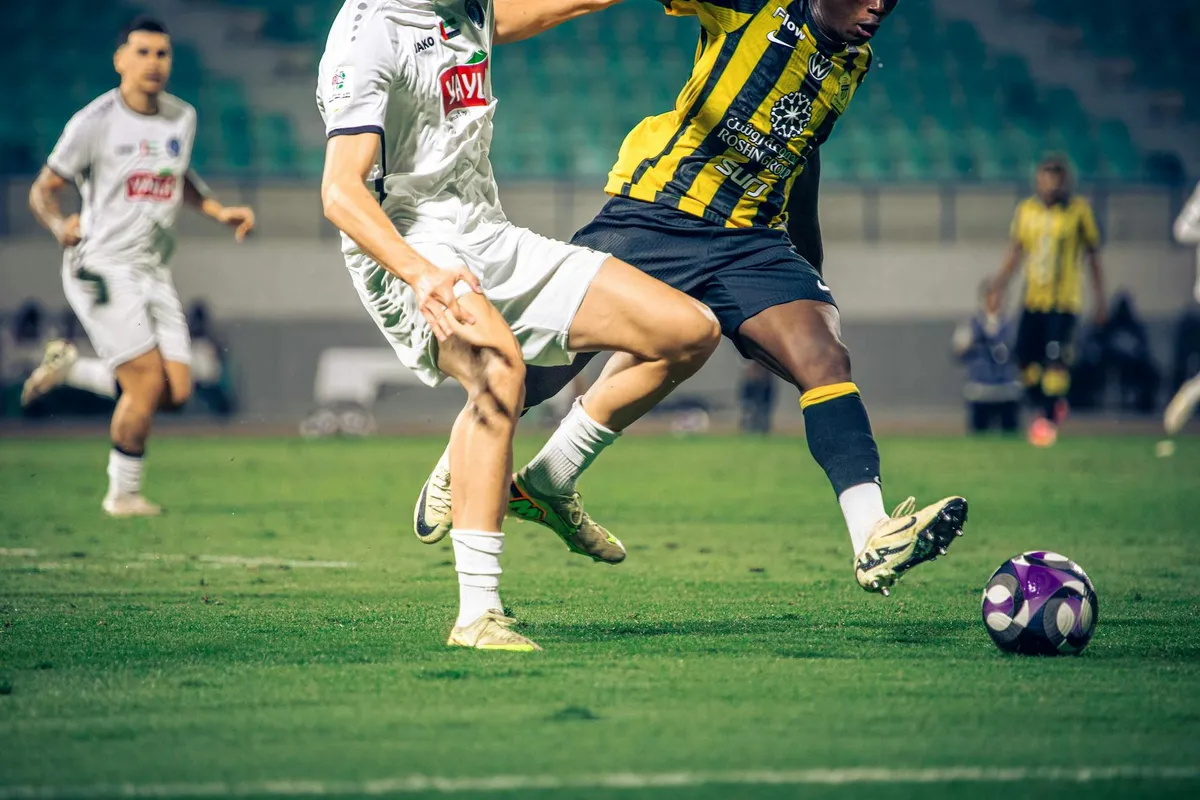
Vinicius Junior is the most-feared left winger in world football. Defenders foul him more than any other forward in Europe. He's booked more, dives more controversially, and provokes more touchline arguments than anyone in La Liga. He's also outscored almost every winger in Europe over the last three seasons. Here's what the numbers say about why he's so devastating — and where his game still has gaps.
1. The 1v1 success rate
Vinicius completes 64 percent of his attempted dribbles in 1v1 situations against opposing fullbacks. The next-best winger in the top five European leagues sits at 58 percent. Six percentage points sounds small until you remember Vinicius attempts ten 1v1 takes per ninety minutes — meaning he beats his man one extra time every other game compared to the next-best winger.
The 64 percent isn't a fluke. It's held across three seasons against three different defensive systems.
2. The shooting profile
Vinicius averages 4.3 shots per ninety, with 1.7 of those coming from inside the six-yard box and 1.1 from the penalty spot zone. That's a shooting profile closer to a centre-forward than a winger.
The reason is that Vinicius shoots almost exclusively from cuts inside — pulling onto his right foot and arriving at the back post on cutbacks. He almost never crosses with his left foot. His shot map is essentially the left half of the penalty box.
3. The xG conversion
His non-penalty xG is 0.51 per ninety. His actual non-penalty goal output is 0.63 per ninety. That's an over-performance of 24 percent across three seasons — meaning he's finishing chances at a substantially higher clip than the model predicts.
For wingers, sustained xG over-performance across multiple seasons is rare. Mo Salah achieves it. Mbappe achieves it. Almost no one else. Vinicius's presence on this list at 23 years old is the data point that matters.
4. The defensive work
Here's where the numbers turn. Vinicius averages 0.4 tackles per ninety, 0.3 interceptions, and 1.1 pressures. Those are bottom-quartile numbers among elite wingers.
The defensive lightness is by design — Carlo Ancelotti structures the Madrid system to keep Vinicius high so he's already in position for transitions. But it means Real Madrid concede a clear avenue for opposing teams to attack down their left side when Vinicius is on the pitch.
5. The set-piece contribution
Vinicius is rarely involved in attacking set pieces. He's the player Madrid wants holding the back post for transitions, not crashing the box for corners. He averages 0.05 goals from corners per ninety, which is essentially zero.
This is a deliberate trade-off and probably the right one — but it means Madrid's set-piece output is constrained because their most-clinical finisher isn't involved.
6. The dive controversy
The numbers around Vinicius and fouling are remarkable. He gets fouled 4.1 times per ninety — the highest in La Liga. He also gets booked for simulation at a rate higher than any other Madrid player, and earns penalty kicks at a rate higher than any other wide forward in Europe.
The simulation accusations are partly perception, partly real. Video analysis suggests he embellishes contact in roughly 35-40 percent of the fouls he wins. That's higher than most peers but not historically unusual for top-tier wingers. The volume of his attempts is what drives the discourse.
7. The right-footed crossing weakness
If there's a tactical gap in Vinicius's game, it's that he's essentially predictable in his attacking decisions. When he gets to the byline, he cuts back almost always with his right foot. When he's heading toward the box, he cuts inside almost always to shoot.
Smart defenders have started pushing him toward his left foot — forcing him wide rather than allowing the inside cut. His left-foot final-third action completion rate drops to 38 percent when defenders show him wide, compared to 62 percent when they show him inside.
It's a small tactical adjustment but it's the only consistent way to neutralize him. Bayern Munich used it against Madrid in their Champions League meetings; Manchester City have used it; Athletic Bilbao have used it. Most La Liga defences don't — and pay for it.
The trajectory
Vinicius is 23. His numbers are at peak-winger level already. The Ballon d'Or discussion is real and the next contract negotiations with Madrid will be one of football's biggest stories.
Where his game still has room to grow: the left-foot finishing, the set-piece contribution, and the defensive engagement. If he adds any of those three, he becomes irrefutably the best winger in world football. Right now it's a debate. In two years it might not be.