
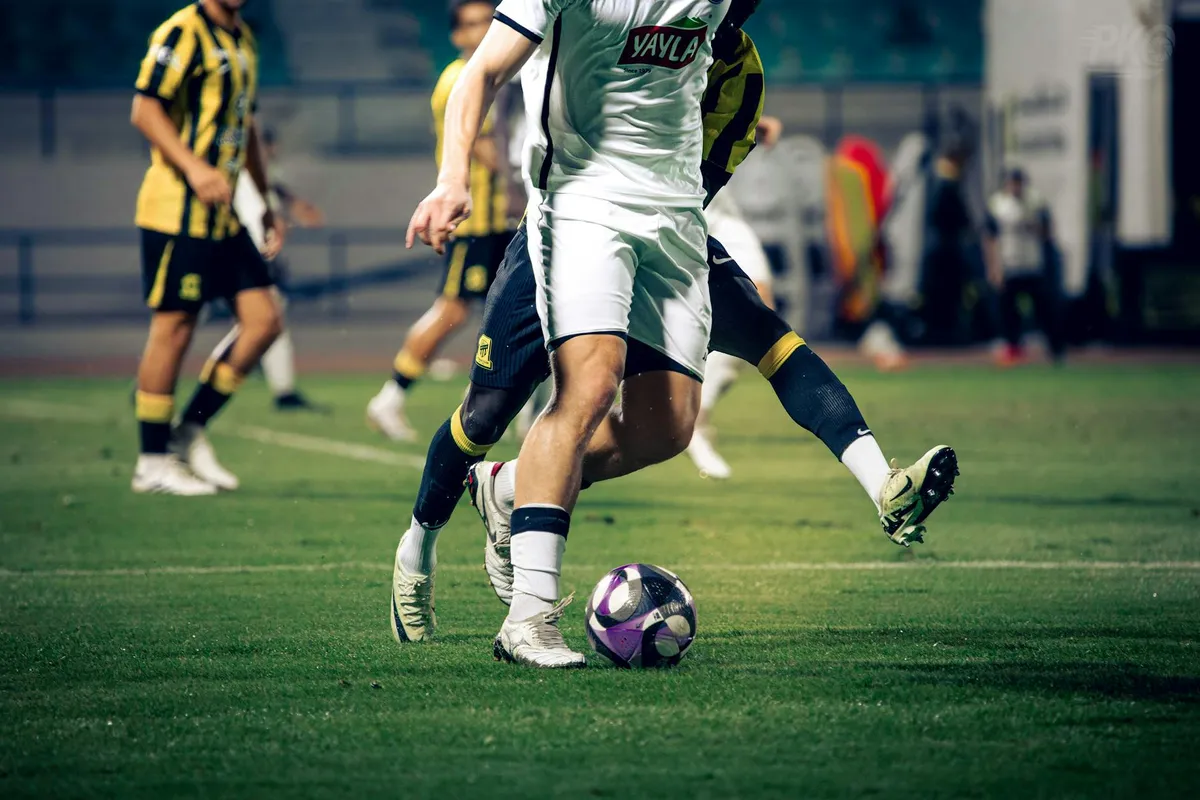
The modern high press isn't about chasing every ball. The best pressing teams in Europe — Pep's City, Arteta's Arsenal, Bayer Leverkusen under Xabi Alonso — share something in common. They wait. They watch. And when a specific cue happens, the whole team triggers at once.
Here's the deal: pressing without triggers wears you out by minute sixty. Pressing with triggers wins you matches. Below are the seven triggers that show up across nearly every elite system.
1. The backwards pass
When the ball travels backwards from a centre-back to the goalkeeper, the pressing team launches. The ball is in the air, the receiver's body is angled away from the press, and any first touch needs to come back toward goal. Maximum vulnerability.
Watch any Arsenal high-press sequence. The trigger is almost always a backwards pass.
2. The slow turn
A midfielder receives the ball with their back to play and needs to turn. The half-second the body needs to rotate is the press trigger. Two or three players close down the moment that touch starts.
This is the trigger that Liverpool's old midfield three lived for. Henderson, Wijnaldum, and Fabinho built entire matches around it.
3. The hospital pass
A teammate plays a ball into a receiver who has a closer opponent than they realize. The pressing team reads the body shape of the receiver — flat-footed, not scanning — and triggers. The receiver gets the ball with no time and the press wins it.
Bielsa's Leeds were the masters of this. They'd sit in shape for ten minutes waiting for one bad pass and then explode.
4. The first touch out of feet
A pass arrives and the receiver's first touch bounces them off-balance — too heavy, too far ahead, too far behind. The press triggers in the second the receiver is recovering control.
This one requires sharp anticipation but produces the cleanest turnovers. The ball is loose, the opponent is reaching, the press arrives first.
5. The throw-in
The thrower has limited passing options because feet aren't in play and the wing is constrained. Pressing teams pack the throw-in zone with three players minimum and force a backward throw or a contested aerial.
Brentford built their entire 2022-23 Premier League campaign around aggressive throw-in pressing. They scored from it dozens of times.
6. The deep goal-kick
The goalkeeper signals long, the centre-backs split wide, the central midfielders drop. The press triggers the moment the keeper plants the standing foot. Front three close goalkeeper passing lanes; midfielders mark the centre-circle receivers tight.
The objective isn't to win the ball back immediately. It's to force the goalkeeper into the long ball — which the press can win 50-50 in the opponent's half.
7. The dribble into traffic
A ball-carrier drives into a congested zone with the head down. The pressing team triggers on the head position — once the carrier stops scanning, the closing-down opportunity opens. Two defenders converge from blind angles.
This is the trigger that's easiest to teach to a press-reliant team. Watch for the head, close the angles, force the loose touch.
The pattern across all seven
What links these triggers? Each one represents a moment where the receiver has less than half a second of available time, and where the body angle of the receiver tells the pressing team exactly where the loose ball will travel.
That's the difference between modern pressing and old-school pressing. Old-school pressing was about effort. Modern pressing is about anticipation — the players who run the most aren't winning the ball. The players who read the cues first are.
The takeaway for fans
Next time you watch a top-six fixture, mute the commentary and watch the front three for thirty seconds. Notice when they sprint and when they walk. The sprint moments are the triggers. Once you start seeing them, you can't un-see them — and you'll understand pressing in a way most match commentary completely misses.